Cymatics Library · Wave physics
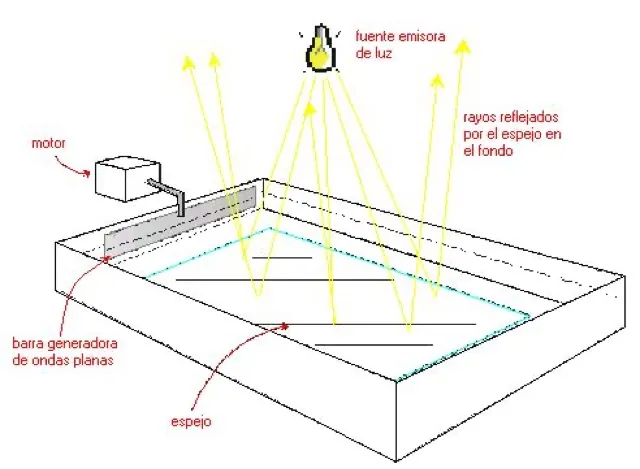
Ripple tank apparatus diagram
Diagram of how a ripple tank works, from Spanish Wikipedia.
A schematic shallow tank with a motor-driven bar making plane waves, a light source above and rays reflected from a mirror on the bottom (Spanish labels).
| Kind | Photograph or engraving |
|---|---|
| Tradition | Wave physics: Ripple tanks |
| Medium | water |
| Evidence | Measured: physics or a measurement |
| Source | Wikimedia Commons: File:Cuba de ondas.jpg |

More from Wave physics
| 6 Hz | Ferrofluid harmonic hexagons Parametric surface waves on a ferrofluid driven by magnetic field. |
|---|---|
| 6.6–6.9 Hz | Bicritical sqrt3 x sqrt3 superlattice Superlattice arising where harmonic and subharmonic modes compete (bicritical f_b = 6.5 Hz). |
| 6.7 Hz | Ferrofluid subharmonic superlattice Superlattice from harmonic/subharmonic mode collision. |
| 9.5 Hz | Square-to-hexagon crossover via superlattices Crossover between incompatible 4-fold and 6-fold symmetries, compared to crystallographic (hcp-fcc) transitions. |
| 11 Hz | Ferrofluid subharmonic squares Square pattern in magnetically forced ferrofluid. |
| 16.5 Hz | Ding-Umbanhowar {6,7} superlattice Superlattice selection in two/three-frequency forcing compared against weakly nonlinear theory. |
| 20 Hz | Ding-Umbanhowar {4,5} quasipattern Quasipatterns, squares and hexagons in {4,5} forcing; adding a third 2w component promotes resonant-angle patterns. |
| 20–70 Hz | Douady near-perfect squares in brimful cell Classic experimental study confirming f/2 response, supercritical onset and the role of meniscus pinning. |