Cymatics Library · Chladni plates
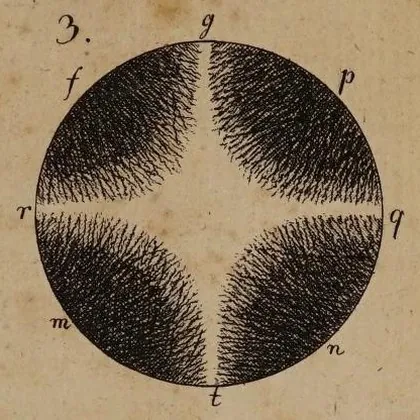
Chladni 1787 Fig. 3
Makes the fundamental vibration of a bell or glass vessel visible through the motion of water
Same two-diameter division as Fig. 2 drawn with the four vibrating quadrants shaded; on a water-filled bell/vessel the water is driven from the four vibrating sections (gq, qt, tr, rg) toward the centre.
| Kind | Cymatic figure |
|---|---|
| Tradition | Chladni plates: Chladni 1787 |
| Lineage | Hooke (1680) flour-on-glass observation; Chladni sand figures |
| Medium | water |
| Mode | fundamental of bell/vessel, 2 nodal diameters |
| Symmetry | 4-fold |
| Evidence | Measured: physics or a measurement |
| Source | Ernst Florens Friedrich Chladni, Entdeckungen über die Theorie des Klanges (Leipzig, 1787) — Source Library scan/OCR (Getty Research Institute copy via Internet Archive) |
More from Chladni plates
| 89 Hz | Circular plate 89 Hz Lecture demonstration of circular-plate modes |
|---|---|
| 107 Hz | Acrylic square plate 24 cm, f1 Experimental study of plate shape vs pattern |
| 107 Hz | Square acrylic Chladni plate resonances Measured resonant frequencies of Chladni plates of different polygon shapes. |
| 112 Hz | Acrylic pentagonal plate 14.5 cm, f1 Experimental study of plate shape vs pattern |
| 120 Hz | UT Austin circular plate figures Lecture demonstration |
| 137 Hz | Square plate 137 Hz Lecture demonstration of square-plate modes |
| 152 Hz | Acrylic triangular plate 24 cm, f1 Experimental study of plate shape vs pattern |
| 154 Hz | Circular plate 154 Hz Lecture demonstration of circular-plate modes |