Inside the granite: what the King's Chamber really does to sound
The King's Chamber is a small granite room, and that is the whole secret of its sound: hard, polished stone on every side, simple proportions, and a granite box inside that rings on its own. The rest, the frequencies and the purposes people attach to it, ranges from careful measurement to pure legend. Here is how I tell them apart.
Standing in the room
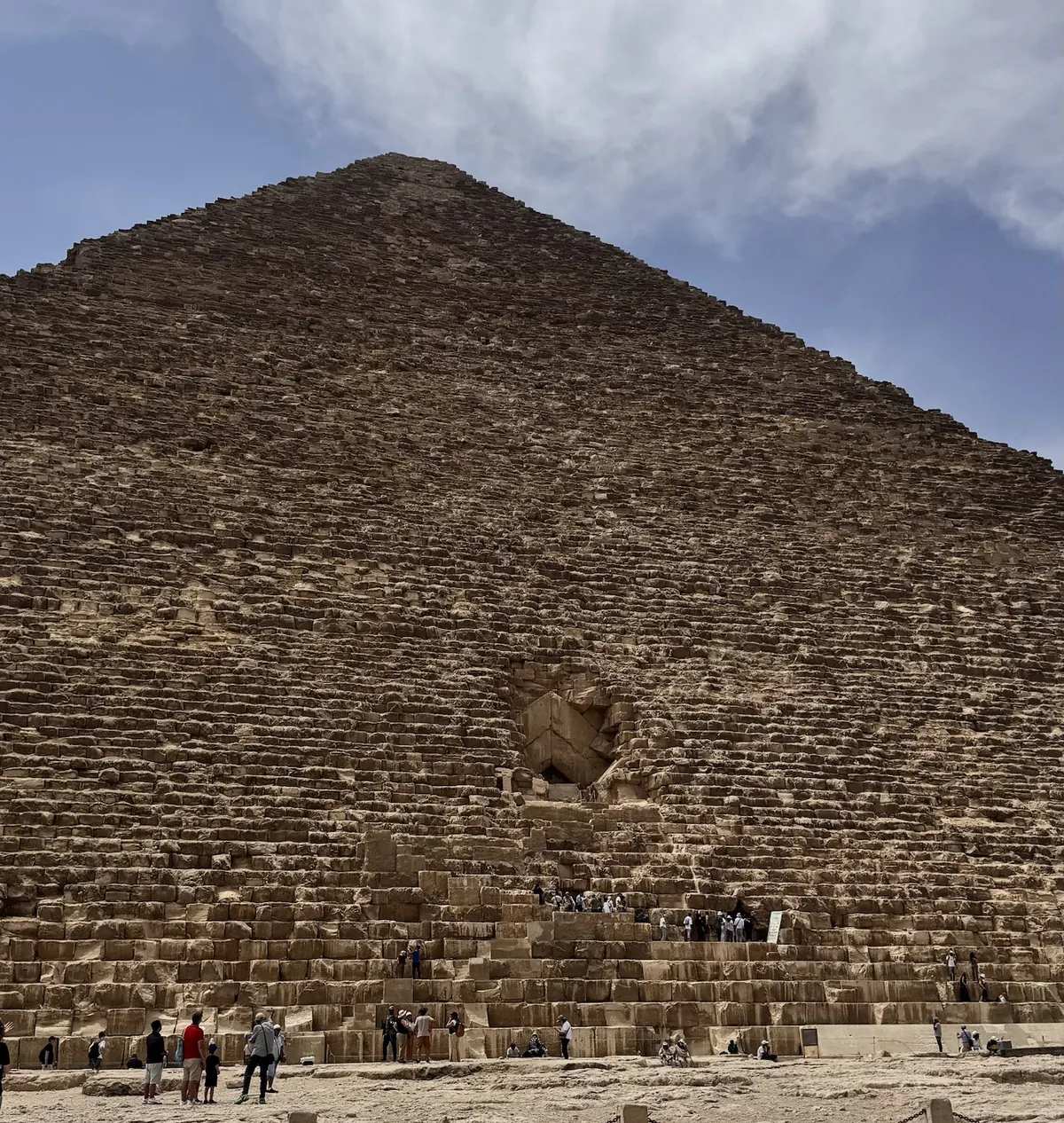
I have stood in the King's Chamber. What struck me first was not a hum or a tone but how the room took every sound and held it. A footstep, a breath, a word: nothing simply ended. It was a profound and personal experience, and I came home wanting to stand in that room again and to let other people stand there too. That is where our King's Chamber reverb began.
But a feeling is not a measurement. If I was going to build a room, I needed to know the room.
What did Flinders Petrie measure?
Most of what we know about the chamber's shape comes from William Matthew Flinders Petrie, who surveyed the Giza pyramids with remarkable care and published The Pyramids and Temples of Gizeh in 1883. His figures for the King's Chamber are about 10.47 m long, 5.234 m wide and 5.80 m high. The floor is a double square, two squares side by side, so its diagonal is √5 times the width.
The walls, floor and ceiling are red granite. Above the flat ceiling sit five stacked relieving chambers that spread the weight of the pyramid. Near the west wall stands the lidless granite coffer, about 2.28 m long, 0.98 m wide and 1.05 m high on the outside. Petrie found no setting-out marks for it and signs that it had been moved, so where it first stood is not known.
Why does the chamber ring for so long?
Granite reflects almost all the sound that hits it. In a room lined with it, sound bounces back and forth for seconds before it dies away. A long decay like that in so small a room is unusual, and you hear it as a room that holds onto you.
The simple box shape adds the second ingredient: room modes. Every rectangular room has frequencies whose wavelengths fit between its walls exactly. Those notes build up into standing waves and ring longer than the rest. With a length of about 10.47 m, the lowest length mode of the King's Chamber sits near 16 Hz, below hearing, and its stronger modes fall through the low range of the human voice. Hum at the right pitch and the room answers.
The third ingredient is the coffer itself: a granite box open at the top, with its own resonances, which you hear most when you lean into it or lie in it.
What have acoustic engineers measured?
Several people have taken instruments into the chamber. The acoustics engineer John Stuart Reid carried out a series of experiments there in 1996 and 1997, and reported that the main resonance of the chamber and that of the coffer were almost identical. An account in Live Sound International (July/August 2000) describes another team measuring inside the pyramid with a TEF analyser; their rough estimate put the resonance of the granite ceiling beams around 300 Hz, and a cruder model of the passages suggested very low resonances from about 2.5 Hz.
The figure you'll see most often is 117 Hz, quoted for the coffer and sometimes for the room. Treat it as a commonly quoted value rather than a single agreed measurement: the room has no one frequency. It reinforces a set of related ones, and which one you hear depends on where you stand and what you sing.
A very different set of numbers comes from a structural study published in Scientific Reports in 2026. Researchers from Egypt and Japan measured vibration at nearly 40 points in and around the pyramid to understand how it survives earthquakes. They found the whole structure vibrates with fundamental frequencies of about 2.0 to 2.6 Hz, well apart from the ground around it at about 0.6 Hz. Those are frequencies of stone and soil moving in an earthquake, not sounds, and they are sometimes mixed up with the acoustic ones.
What is legend?
That the room was designed to resonate at a chosen frequency, that it was built to heal, to open consciousness or to transmit energy: these are ideas, some of them beautiful, but there is no evidence for them in the stones or the surveys. The hard surfaces and simple proportions are enough to explain what you hear. I find the real thing more than enough. A room that makes four and a half thousand years of silence audible doesn't need to be a machine as well.
How did we model the room?
Our King's Chamber is built from Petrie's dimensions, not from a recording. Four engines share one model of the room: exact early reflections from the granite walls, a bank of about 300 room modes below 190 Hz, the coffer's own cavity and a granite resonance near 117 Hz, and a long tail. Because it's a model, every one of those depends on where the source and the listener stand, so you can drag the listener to the doorway, the centre, or into the coffer, and hear the low end change the way it does in the real room. A recording made at one spot can't do that.
We measure the result on every build. At the centre of the room the decay time is about 4 seconds in the low and middle range, close to the roughly 4 seconds reported for the real chamber. And because nobody knows where the coffer first stood, you choose: Petrie's position, two later proposals, or centred.
It is not the room. Nothing is. But it lets you stand where I stood, and listen.
Sources
- W. M. Flinders Petrie, The Pyramids and Temples of Gizeh, London, 1883.
- John Stuart Reid, acoustic experiments in the Great Pyramid, 1996–97 (interview: "Acoustic Experiments in the Great Pyramid", Laura Lee Show).
- "The Great Pyramid: Early Reflections, Ancient Echoes", Live Sound International, July/August 2000 (republished on ProSoundWeb).
- "How ancient builders made the Great Pyramid of Giza nearly earthquake-proof", National Geographic, 21 May 2026, on the Egyptian–Japanese vibration study in Scientific Reports.
- Sacred Audio, King's Chamber research notes and measurements.
More: King's Chamber acoustics explained · sacred space reverb plugins compared