Instruments / Top Loop Instrument
Sundial
One click, a finished psy top loop.
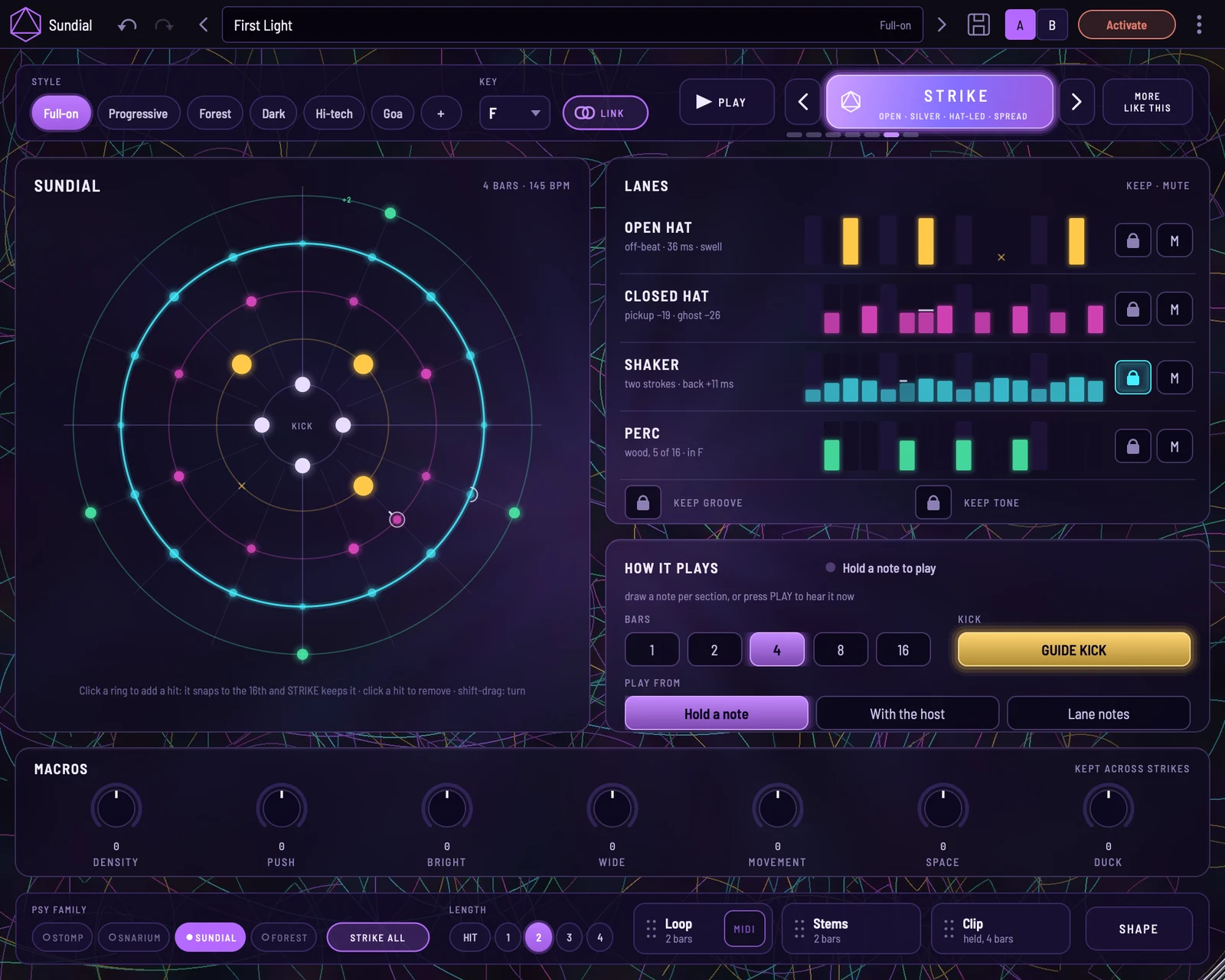
The off-beat hat, the shaker, the ghosts and pickups and tuned perc, locked to your host and in your key. Press STRIKE, keep the parts you like, strike again.
Coming soon
Create a free account and tick the news box: we'll write the day it opens.
Key features
- Four lanes: open hat, closed hat, shaker and tuned perc, each with its own lock
- Loops of 1 to 16 bars, odd bars answering even ones, a fill at the phrase end
- Locked to the host and the song's bars, to the sample
- Every hit synthesised: noise hats and a bead-model shaker, no samples
- STRIKE: a finished top loop in one click, in eight psy styles
- Drag out the loop, one stem per lane, or MIDI
What is Sundial?
Sundial is an undefined from Sacred Audio, coming soon for Mac and Windows (VST3, AU and Standalone). The off-beat hat, the shaker, the ghosts and pickups and tuned perc, locked to your host and in your key. Press STRIKE, keep the parts you like, strike again.
The top loop is what makes a psy groove roll: the open hat on the off-beat, a shaker pushing behind it, ghosts and pickups in between. Sundial builds all of it from nothing, with no samples.
Pick a style and press STRIKE. You get four lanes, open hat, closed hat, shaker and perc, playing in time with your track and tuned to its key. Keep a lane, strike again, and drag the result out as a loop, as stems or as MIDI.
Phrases, not just bars
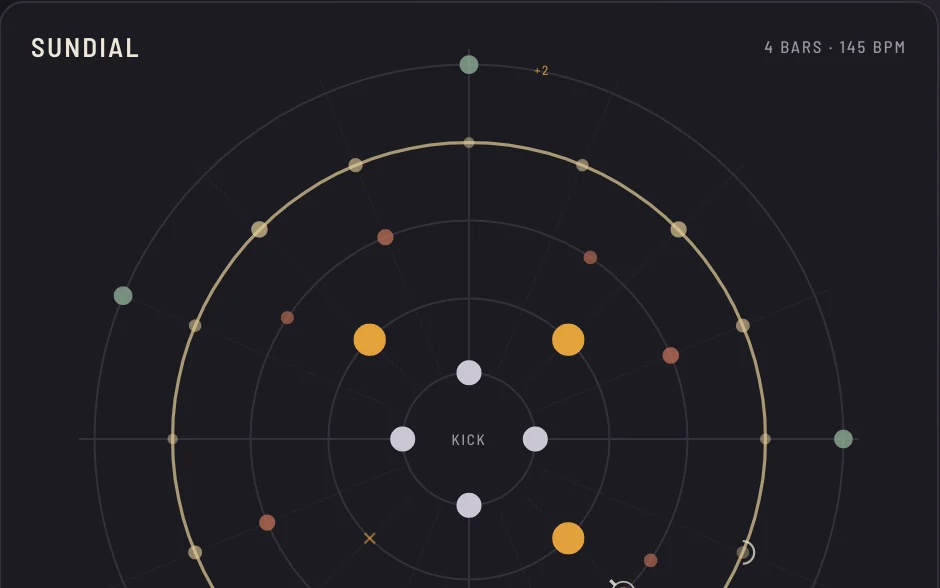
Choose 1, 2, 4, 8 or 16 bars. Odd bars answer the even ones, and the last bar of the phrase gets a fill: a 32nd crescendo, 16th triplets, or 32nds into an open hat.
Three ways to play
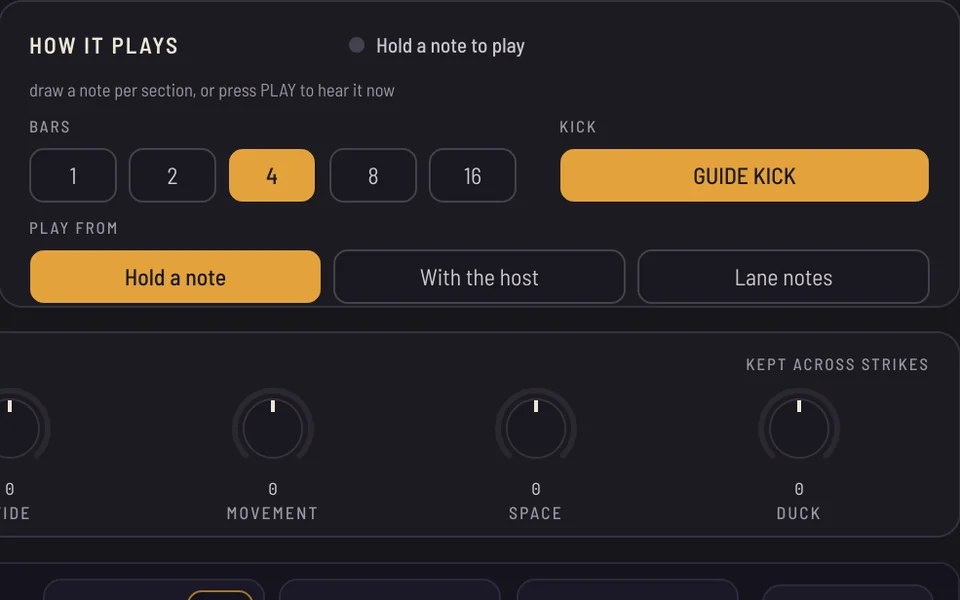
Hold a note and it plays, locked to the song's bars, so a 4-bar loop lines up with your 4-bar phrases. Or let it play whenever the host plays. Or send it one note per lane, C3 to G3, and write the groove yourself.
Tuned perc
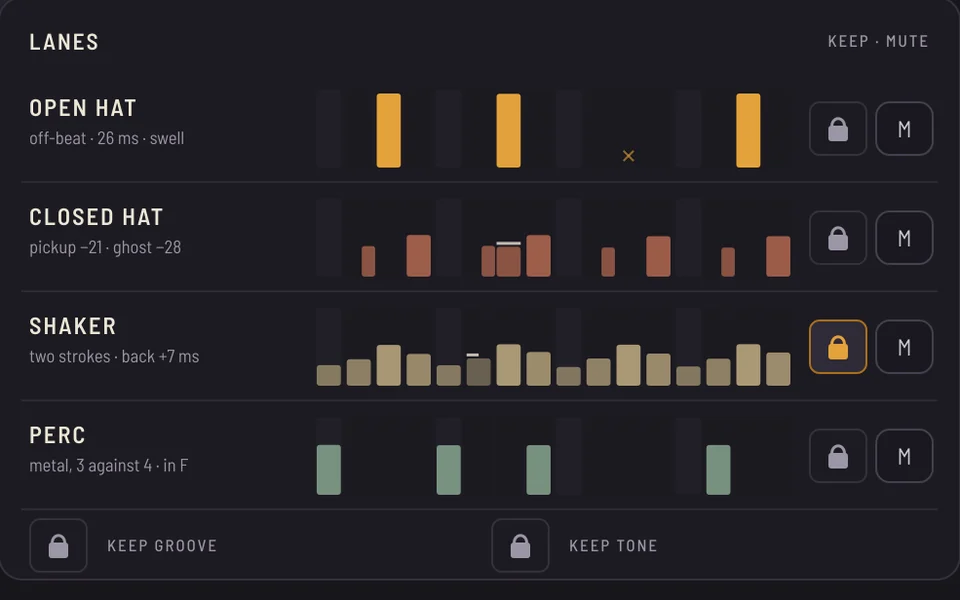
The perc lane is short FM metal or a modal wood bar, high-passed at 1.5 kHz and tuned to the key on a minor pentatonic. It never falls on the kick.
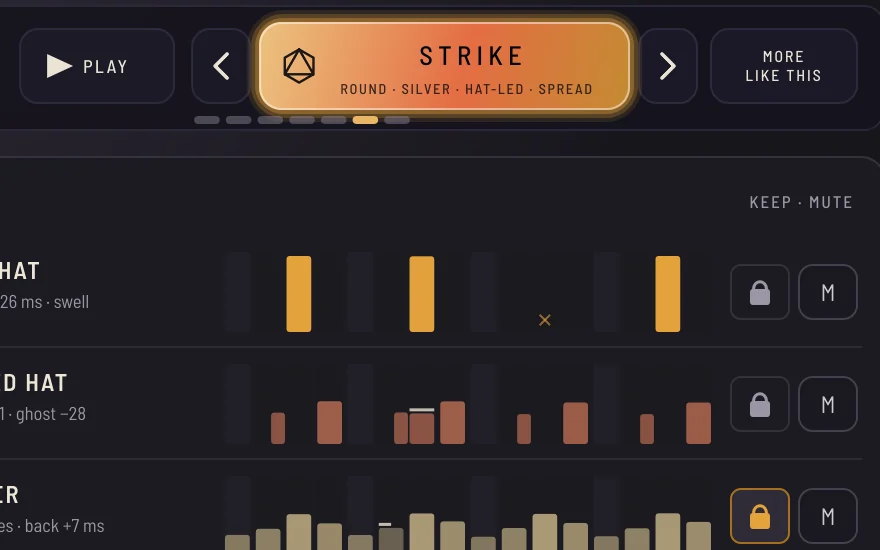
Strike and keep
STRIKE makes a new loop in Full-on, Progressive, Forest, Hi-tech, Goa, Dark, Psy-techno or Zenonesque. Back, More like this and Next move through your strikes; the last 16 are shown and 64 are kept. Lock a lane, or the groove or the tone, and it stays.
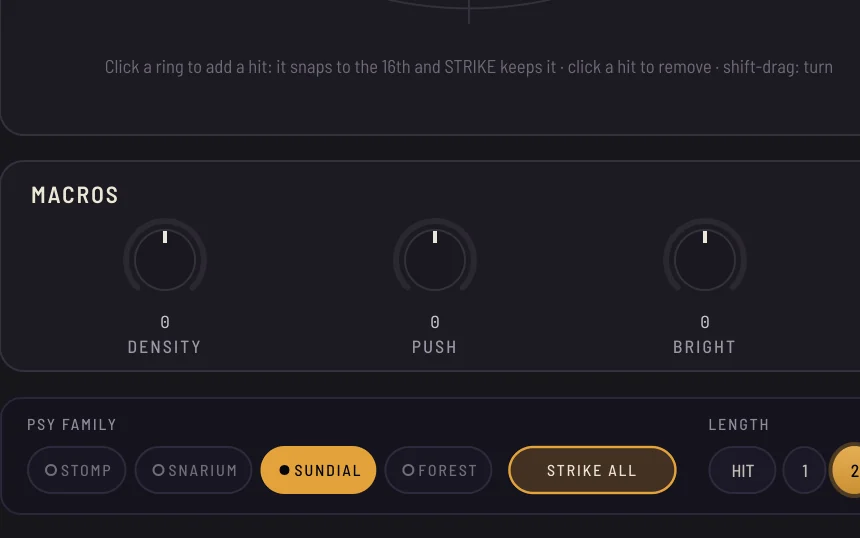
Seven moves on top
Density adds shaker 16ths, ghosts, rolls and ratchets. Push drags the shaker's back stroke and swings the hat. Bright, Wide, Movement, Space and Duck do what they say. They sit on top of any strike and stay when you strike again.
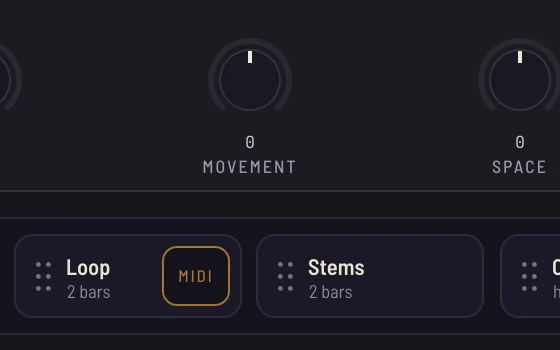
Drag it out
LOOP gives one seamless WAV at the host tempo, with the tail wrapped to the start. STEMS gives one WAV per lane. MIDI gives the groove on the lane notes, to edit on a Sundial track. GUIDE KICK adds a kick so you can hear the space you leave for it.
In the studio
Put Sundial on a MIDI track and draw one long note per section, or drag out CLIP. Set the key and strike in Full-on until the off-beat feels right, then lock the open hat and strike for a new shaker. Turn on GUIDE KICK to hear the gap, raise Duck to give the kick more room, and push Density up for the second half of the drop. When it's right, drag out STEMS and mix each lane on its own.
How it's built
The modelling, the research and the choices behind Sundial.
Where does the sound come from?
We measured pro psy top loops and a recorded shaker, kept only the numbers, and fitted the engine to them. The hats are three decorrelated noise channels through a fitted EQ, which gives the width and a broadband top with no tonal lines. The shaker is a bead model: the collision rate follows the stroke's energy, the back stroke lands late, and the beads keep sizzling between strokes.
Why is the kick's 16th so quiet?
Because it is in the loops we measured. The off-beat open hat carries the groove. A pickup on the last 16th sits about 20 dB under it, a ghost on the second about 26 dB under, and the 16th on the kick stays almost silent.
How do you check it?
Every style is compared with the reference loops on eight measures: brightness, width, the floor between hits, crest, density, bar-to-bar and hit-to-hit variation, and decay. Each build also checks host sync to within 2 samples from 120 to 174 BPM, the loop, the fill bar, every preset's level and peak, and MIDI export.
Details
| Category | Instruments: Top Loop Instrument |
|---|---|
| Formats | VST3, AU (Mac), Standalone |
| Type | Instrument (top loop generator) |
| Output | Stereo |
| Lanes | Open hat, closed hat, shaker, perc |
| Loop length | 1, 2, 4, 8 or 16 bars |
| Factory presets | 24, three per style |
| CPU | About 2 % of one core with a busy Forest loop and the guide kick |
| macOS | macOS 11 or later, Apple Silicon and Intel |
| Windows | Windows 10 or 11, 64-bit |
Questions about Sundial
What is Sundial?
Sundial is an undefined from Sacred Audio, coming soon for Mac and Windows (VST3, AU and Standalone). The off-beat hat, the shaker, the ghosts and pickups and tuned perc, locked to your host and in your key. Press STRIKE, keep the parts you like, strike again.
When is Sundial released?
Sundial is in development. Create a free account and tick the news box, and we'll e-mail you the day it opens, with a free trial.
Will Sundial run on Windows?
Yes. It will be available for macOS 11 or later (Apple Silicon and Intel) and for Windows 10 or 11 (64-bit).