Instruments / Synth
Harmonia Mundi
Seven planets, each singing its own vowel.
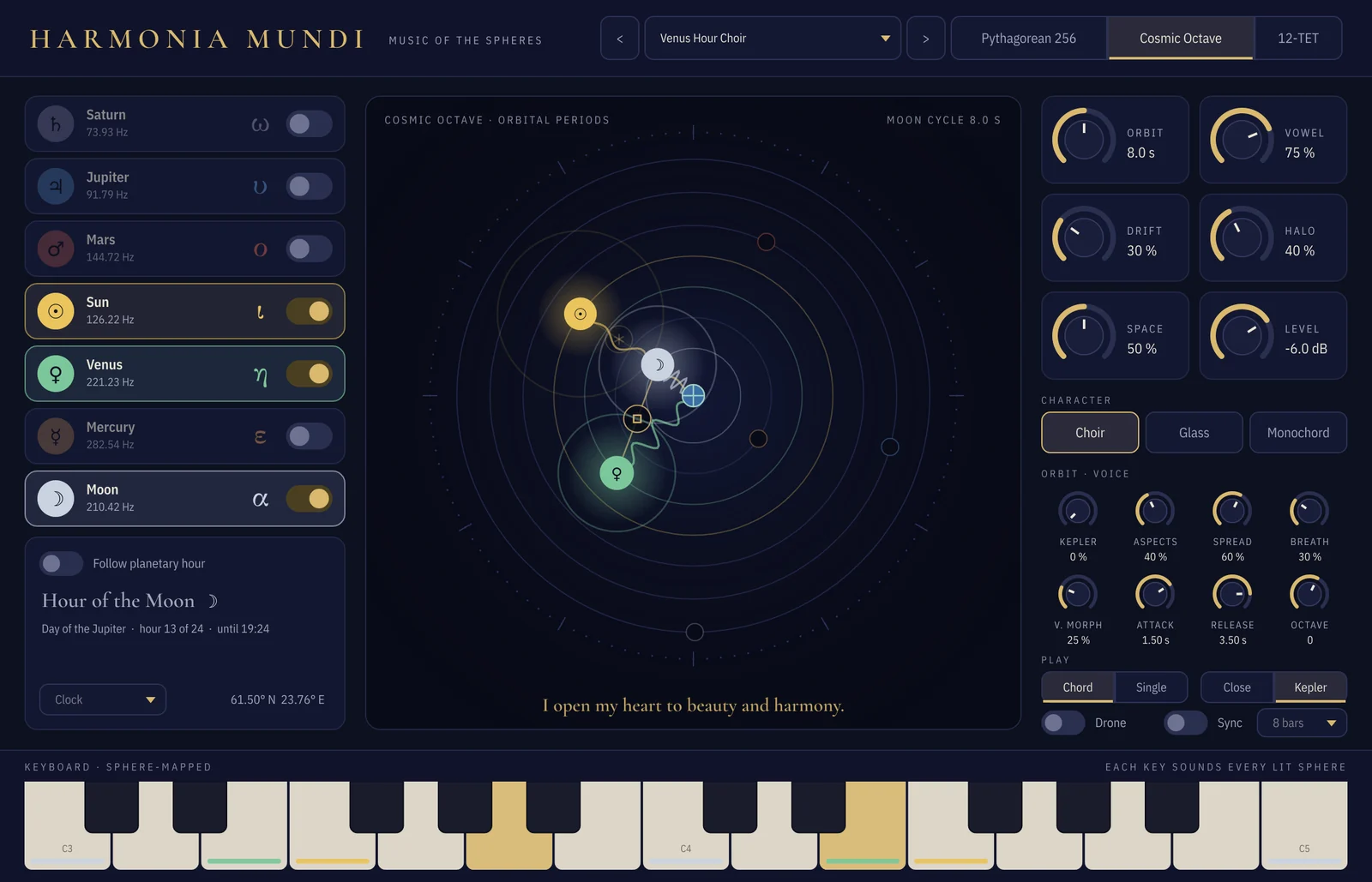
A choir synth of the seven classical planets. Each is tuned to its sphere and sung on its Greek vowel, and they circle the Earth at their true speeds.
Coming soon
Create a free account and tick the news box: we'll write the day it opens.
Key features
- Seven planet voices, Saturn to the Moon, each on or off
- Greek vowels from three-formant tables
- Choir, Glass bowls and Monochord characters
- Pythagorean 256 Hz, Cousto's Cosmic Octave or equal temperament
- Orbits at true sidereal ratios, free or synced to 64 bars
- Follows the planetary hour from your real sunrise and sunset
What is Harmonia Mundi?
Harmonia Mundi is a planetary choir synth plug-in from Sacred Audio, coming soon for macOS (VST3, AU and Standalone). A choir synth of the seven classical planets. Each is tuned to its sphere and sung on its Greek vowel, and they circle the Earth at their true speeds.
Pythagoras heard the planets sing. Harmonia Mundi gives each of the seven classical planets a voice, tuned to its sphere and sung on its Greek vowel.
They circle the Earth at their true sidereal ratios, and the orbit moves the sound: pan, breath, pitch glide and vowel. When two planets form an aspect, the chord blooms.
The spheres as a choir
Saturn, Jupiter, Mars, the Sun, Venus, Mercury and the Moon, in Chaldean order. Play them as a chord, one sphere per key, or as a held drone.
Kepler's voicing
Voice the planets after Kepler's Harmonices Mundi, or close together. Kepler pitch glide lets each voice slide with its orbit.
Aspects bloom
Conjunction, sextile, square, trine and opposition: when the orbit lines two planets up, their chord opens.
How it's built
The modelling, the research and the choices behind Harmonia Mundi.
Where do the tunings come from?
Three systems: the Pythagorean tradition with C = 256 Hz, the intervals of Kepler's Harmonices Mundi, Book V (1619), and Hans Cousto's The Cosmic Octave (1978), where each planet's orbit is raised by octaves into hearing: Saturn at 147.85 Hz, the Moon at 210.42 Hz.
How are the voices made?
Each planet is additive: 24 partials and a halo of 6 more, sung through formant filters for its Greek vowel. The orbit periods are real, scaled down: Saturn 10,759 days, the Moon 27.32 days.
How does it know the planetary hour?
From the standard sunrise equation for your location, accurate to a minute or two, with the hours in Chaldean order. It's tested for Tampere and for polar night on Svalbard.
10 factory presets
Each with an intention
- Venus Hour Choir
- Music of the Spheres
- Saturn Ground
- Jupiter Expansion
- Mars Ignition
- Mercury Messenger
- Lunar Tides
- Kepler's Song
- Hour Follower
- Solar Heart
Details
| Category | Instruments: Synth |
|---|---|
| Formats | VST3, AU, Standalone |
| Type | Instrument (synth) |
| macOS | macOS 11 or later, Apple Silicon and Intel |
| Release | Coming soon |
Questions about Harmonia Mundi
What is Harmonia Mundi?
Harmonia Mundi is a planetary choir synth plug-in from Sacred Audio, coming soon for macOS (VST3, AU and Standalone). A choir synth of the seven classical planets. Each is tuned to its sphere and sung on its Greek vowel, and they circle the Earth at their true speeds.
When is Harmonia Mundi released?
Harmonia Mundi is in development. Create a free account and tick the news box, and we'll e-mail you the day it opens, with a free trial.
Will Harmonia Mundi run on Windows?
The first release is for macOS 11 or later, on Apple Silicon and Intel Macs. Windows versions are planned.